• HOME
  • CHEETAHS
    • Cheetah Facts & Science
    • Life of Cheetahs
    • Threats to Cheetahs
    • Cheetahs Near You
  • DISCOVER WILDLIFE
  • SHOP
  • ABOUT
    • Cheetah Heroes

DAILY LIFE OF CHEETAHS

These cheetahs are walking together in the scrubland of Kenya.

Where do Cheetahs Live?

What type of habitat (natural home) do cheetahs live in?
Most of the cheetahs in the world live in grasslands on the African savanna. Grasslands can be very thick with brush. In other parts of the world cheetahs live on scrub lands, deserts and mountainous areas.
Where do cheetahs live in the world?
The largest number of wild cheetahs live in Namibia, Africa. Small populations live in other parts of Africa and less than 50 Asiatic cheetahs live in Iran.
Wild Cheetah Population Range
Map of Africa & Asia with the world's cheetah populations denoted. Historic and present cheetah populations.
Source: Wildlife Population Monitoring
What countries do wild cheetahs live in?
Cheetahs have a range through many different countries in Africa. Also a smaller population live in Iran. Algeria Angola Botswana Cameroon Central Africa Republic Chad Ethiopis India* (8 cheetahs translocated to India, 2022) Iran Kenya Namibia** (largest population & where CCF is located) Niger Nigeria Somalia South Africa Sudan Tanzania Uganda Zambia Zimbabwe Also in parts of Sahel (a transition area in Africa between the Sahara to the north and the Sudanian Savanna to the south)

INDIA - A CHEETAH REINTRODUCTION

INDIA & CHEETAHS: HISTORY

Historically India's ecosystem had cheetahs along with lions, tigers and leopards. The cheetah population numbers had been decreasing for many years from loss of habitat, lack of prey and trophy hunting. About 70 years ago the very last cheetahs were hunted causing India to be a country without cheetahs. Cheetahs were officially declared extinct in India in 1952.
Reintroduced cheetah in Kuno National Park, India
@2022 Tribune India

CURRENT INDIA'S CHEETAH POPULATION

July, 2026 Currently the cheetah population is approximately 50 - 53 animals with several litters being born in India.
A bright yellow cheetah drawing.

Cheetah Chirps

WHERE DOES THE WORD "CHEETAH" COME FROM?

It originated from the Sanskrit language of India. Cheetah is derived from the word "chitraka" meaning the "spotted one" in Sanskrit.

CHEETAH REINTRODUCTION

*After 70 years cheetahs are reintroduced.

For over a decade, India has been working with world cheetah conservation organizations to bring cheetahs back to India. It finally came to furition in 2022. Cheetahs were officially reintroduced to India on September 16, 2022 when eight wild cheetahs from Namibia, Africa flew on a large jet plane to India. The cheetahs were a gift from the country of Namibia to the country of India. The cheetahs were escorted and closely monitored by the wildlife vets and experts of the Cheetah Conservation Fund. All arrived safely after an 18-hour transcontinental trip and were introduced to the Kuno National Park on the Prime Minister's birthday September 17. Since 2022, more cheetahs have been translocated to India to help populate their multi-year plan of cheetah reintroduction. South African contributed 12 more cheetahs in February 2023. With Botswana giving 9 cheetahs in February 2026. Most of the cheetahs live in the protected area of Kuno National Park.

How do Cheetahs Survive?

*Science terms explained:
Apex predator is an animal that is at the top of its food chain and are not preyed upon by other animals.
Ungulates are animals with hoofs on their feet which acts like a large toe that they walk on. Ungulates are hooved animals.
Scientists identify plants and animals by their active periods: nocturnal (active at nightime) and diurnal (active during the day). There is another type of active period called crepusular where animals are active during early morning (dawn) and late afternoon (dusk).
What type of habitat (home) do cheetahs live in?
Most of the cheetahs in the world live in grasslands on the African savanna. Grasslands can be very thick with brush. In other parts of the world cheetahs live on scrub lands, deserts and mountainous areas.
A cheetah's rear side as it runs away with it's legs together and tail high.
Do cheetahs move around or roam a lot?
Cheetahs travel often looking for food or mates.  Male cheetahs travel longer distances then female cheetahs. Scientists call the land or territory cheetahs commonly travel their "cheetah' home ranges. A cheetah can travel an estimated 100 miles in its home range and average 12- 50 miles a week.
What is a group of cheetahs called?
Male cheetahs, typically brothers, form a coalition and are the small groups of adult cheetahs seen on the savanna. They roam, hunt and often stay together for life. Some male cheetahs live alone.
Female cheetahs live by themselves unless they are caring for their baby cheetahs (cubs).
Do cheetahs have predators (enemies)?
Cheetahs have to be careful around lions, hyenas, leopards, eagles and other male cheetahs. These animals can threaten their meals, territories and small cubs.
Are cheetahs good hunters?
Yes! Cheetahs have great success in capturing its food but they are often worn out by the chase and need time to rest. This presents a problem for the cheetah because they have trouble defending their fresh kill. 
Often their meal is stolen by lions, hyenas, or wild dogs. Cheetahs will not fight to keep their food but take 'flight' and leave the food to the larger animals. How frustrating!
Two cheetahs spend time up in a play tree at the Cheetah Conservation Fund.
©CheetahConservationFund
Can cheetahs climb trees?
Cheetahs are not very good climbers but can use large horizontal limbs to get up into the trees and use them as lookout areas for prey. Cheetahs will scent mark these 'play trees' with their urine or scat (poop). Groups of male cheetahs will often scent the same tree and leave their mark to discourage other male cheetahs from using the same tree.  This is what cats do to mark their territory.
How do cheetahs EAT?
Cheetahs have sharp teeth and specialized tongues that are covered with lots of tiny spines. The spines on the tongue help to scrape fur and remove meat from bones.
During a mid-day safari ride a beautiful cheetah was spotted on the Masai Mara.
When do cheetahs hunt for food?
Typically cheetahs hunt primarily at early morning (dawn) and late afternoon (dusk). Cheetahs are considered *crepusular animals using the dim light of the dawn and dusk for their hunting advantage. Cheetahs were once thought to be only dawn and dusk hunters but a recent documentary shot at night time showed that cheetahs can take their prey in the dark of night too. Watch the "Night on Earth" (2020 Netflix) documentary to see cheetahs hunding at night. Cheetahs are excellent hunters and take whatever opportunity they have to get their next meal.
Are cheetahs considered *apex predators?
Yes cheetahs are at the top of their food chain. They are threatened by other animals but do not have any animals specifically hunting them. Cheetahs are one of the BEST hunters on the savanna hunting a variety of species. This helps keep the biodiversity of the ecosystem healthy and viable for all species. If cheetahs were not present in the ecosystem it would cause an imbalance and decrease in the biodiversity needed for a healthy ecosystem.
Brightly colored cheetah drawn with yellow and black markers.

CHEETAH JOKE

WHAT IS A CHEETAH'S FAVORITE FOOD?

FAST FOOD!
How often do cheetahs eat?
Male cheetahs and female cheetahs hunt every 2-3 days while mama cheetahs have to hunt every day to feed hungry growing cubs. No grocery stores for them.
What kind of food do cheetahs eat?
Cheetahs are meat-eaters (carnivores). They eat mostly *ungulates that are the smaller antelopes like Thomson's gazelle, springbok, steenbok, duiker, the young of larger antelopes, young warthogs, as well as hares, rodents and game birds.
Cheetahs have a favorite food!
This is a cheetah's favorite food. Thomson's gazelles standing in green grassland.
In East African countries (Kenya, Tanzania), their favorite food is the Thomson's gazelle.
Thomson's gazelles are herbivores which means they eat grasses and are often seen on the savanna grazing. Thomson's gazelles have great hearing which can help them tell when predators are around. They too can run fast and give cheetahs a good chase. Thomson's gazelles run up to 50 miles per hour and can make sudden leaps into the air. This type of behavior is called pronking. Thomson's gazelles are mostly found in East African countries like Kenya and Tanzania.
One Springbok jumps high over another Springbok in Namibia.
In Southwest African countries (Namibia, South Africa), their favorite food is the Springbok.
Springbok are small antelopes that live in Southwest African countries like Namibia, South Africa, Botswana, parts of Angola. Thomson's gazelles do not live in these countries. Springbok are herbivores who eat and graze on grasses on the savanna.
How do cheetah hunt for food?
Cheetahs often hide in the bush and spend a lot of time waiting for the best opportunity. They take their time stalking to get close to their prey. The cheetah then darts out and the chase starts! The chase is quick often lasting only 20 seconds and the prey is caught. The cheetah clamps down on the neck/throat to cut off the air supply of the animal.  That's a different kind of takeout!
How long do cheetahs live?
Cheetahs can live 10 -12 years in the wild. Male cheetahs often have shorter lives because of they have to fight for territory. Captive cheetahs can live up to 16 years.

Mama Cheetahs & Cubs

Is there a time of year for cheetah mating (making babies)?
No. Cheetahs have a natural instinct to mate and make babies which happens year round. Typically the female will indicate she's interested by urinating on a tree. The urine leaves a strong smell that will draw in male cheetahs.
What are baby cheetahs called?
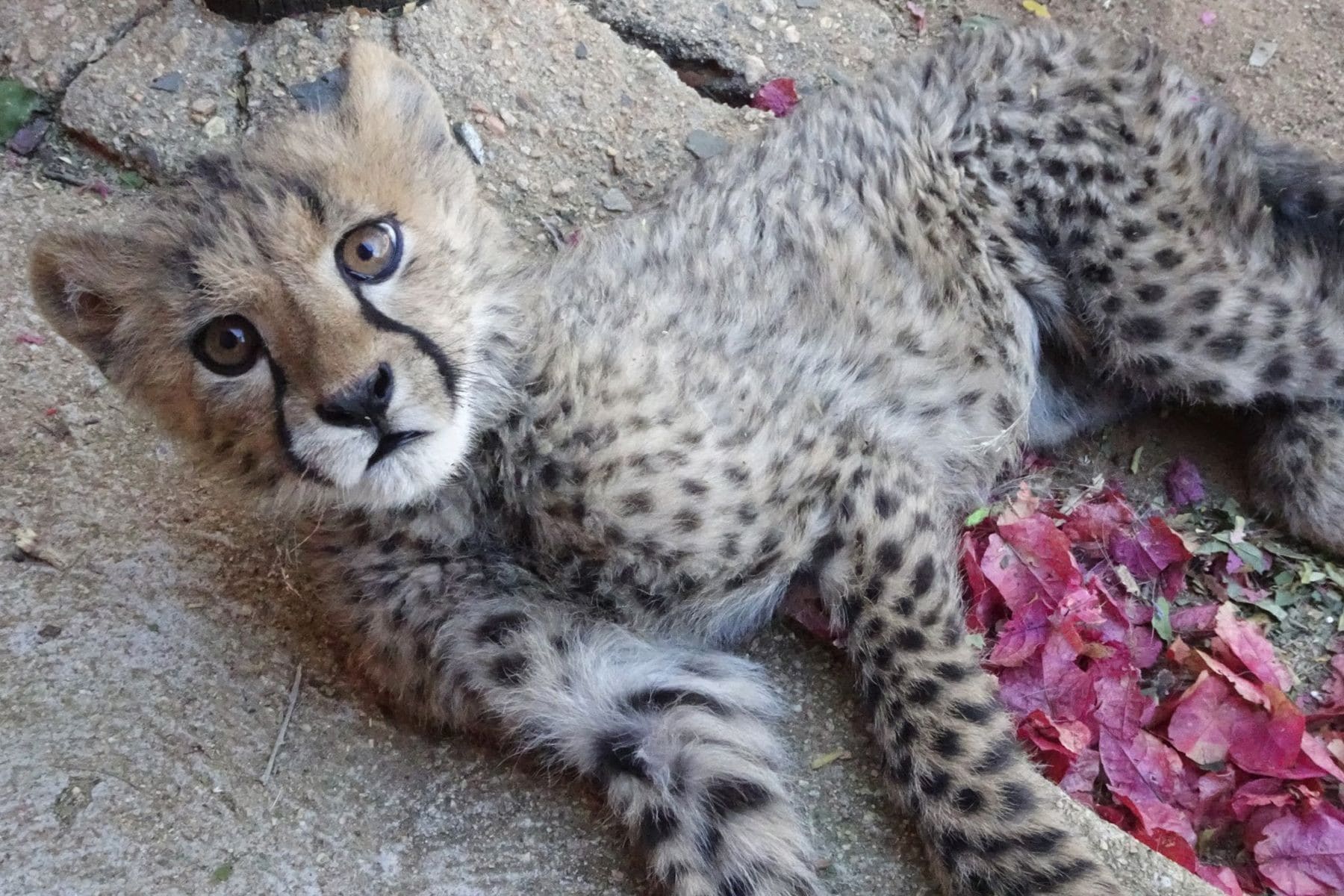
Baby cheetahs are called cubs.
A young orphaned cheetah saved by the Cheetah Conservation Fund.
Dominic at Cheetah Conservation Fund, 2018
How many cubs can a cheetah have?
Most female cheetahs typically have 3-5 baby cubs in the wild.
Cheetah cubs can be mistaken for Honey Badgers!
A Honey Badger walks through the grassland of the savanna. The body is greatly hidden by the tall grasses.
Honey Badger, Kruger NP, South Africa
Yes that's true! The fluff on the cheetah cubs looks much like a honey badger and this can help protect them from predators. Many predators don't want to mess with honey badgers. Honey badgers can be ferocious (mean) and often attack animals larger than itself.
Who raises the cheetah cubs?
Mama cheetahs raise their cubs by themselves and do a great job as a single parent. They are with them for over a year (about 18 months). Mama cheetahs spend a lot of time hunting to feed her growing kids. and teaching the cubs to hunt for food (prey).
What do cheetah cubs look like?
They are CUTIES! The cubs have big eyes, spots and fluffy hair make them look very cute. Cheetah cubs are born with fluffy light grey/tan fur on their heads that runs the length of their bodies. This is known as a mantle. This mantle helps the cubs blend into their environment and  camouflage them.
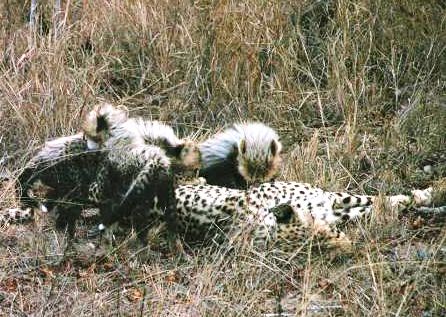
Mama cheetah and her young cheetah cubs that look like honey badgers at this age.
Can cheetah cubs see when first born?
Nope, cheetahs are born blind. Their eyes will start to see about 12 days after birth. Cheetah cubs eventually develop good eyesight that will help them to spot prey once they are ready to hunt.
Are cheetah cubs born to hunt?
No, mama cheetahs teach the cubs to hunt for food (prey) when they are 12-15 months old. Although cheetah cubs are born with a natural instinct to explore and play. Just like a human baby!
image
Some people talk to animals, not many listen though. That's the problem. -Winnie the Pooh (A.A. Milne)
All images are original unless indicated and cannot be reproduced, distributed, or used without expressed written permission.
© 2026 Cheetah Kids Explorer. All rights reserved.
Thank you for your support! A % of the proceeds is donated to organizations helping to save wildlife & their habitats.

We use cookies to enable essential functionality on our website, and analyze website traffic. By clicking Accept you consent to our use of cookies. Cookies and Privacy Policy.

Your Cookie Settings

We use cookies to enable essential functionality on our website and analyze website traffic. For more information, read our Cookies and Privacy Policy below.

Cookie Categories
Essential

These cookies are strictly necessary to provide you with services available through our websites.

Analytics

These cookies collect information that is used in aggregate and in an anonymized form to help us understand how our website is being used and how effectively our site is performing.