Cheetahs are the world's FASTEST land mammal!
Cheetahs run in quick short bursts up to 70 mph (113km/hr), reaching 45 mph is just 2 seconds! FASTEST on Earth!
HOW DO CHEETAHS RUN SO FAST?
It's in the way they are BUILT!
Outer Workings - Physical Structure/Anatomy
Size of Adult Cheetahs
- Body size: 44" to 56" long (112 - 142 centimeters)
- Tail size: 26" to 33" (66 to 84 centimeters)
- Body height: 24.4" to 37.2" (62 t0 94.5 centimeters)
- Body weight: 55 to 145 pounds (24 to 64 kilograms)
- Male cheetahs are typically bigger than females.

Spring-like Backbone
A spring-like backbone helps cheetahs burst forward and it is flexible so it can move easily when running to catch its prey.
Long Powerful Legs
Their long very powerful legs can cover up to 20 feet in one stride helping them gain speed quickly. These powerful legs help them change directions faster than any other land animal.
Cheetahs have good camouflage.
Cheetahs have lots of black solid spots to help them camouflage in their habitat on the savanna. This makes it harder for predators to see cheetahs in the tall grasses.
A fascinating fact is that the black spots grow out of black spotted skin while the yellowish-beige fur grows out of yellowish-beige skin.

Cheetah Strides
When a cheetah runs at one point during its long stride,
ALL four legs of its body are OFF the ground.
Looks like it could be flying. Amazing animal!

Lean Muscular Bodies
Their lean muscular bodies help them move quickly and fast.
Semi-Retractable Claws
Semi-retractable claws (similar to claws on dogs) give cheetahs the ability to grip the hard ground. They also have hard pads with ridges on the bottom of their paws that help provide traction with better gripping and less slipping.

Narrow Heads
Their narrow head helps them move through the air (aerodynamics) easier. This reduces the amount of drag or wind resistance that could slow them down when running.
Long Flat Tail with Unique Markings
A long, flat tail acts tike a steering wheel when the cheetah is running. The tail moves in a way that helps with balance and direction.
Every cheetah has a different marking on their tail. They have long tails with stripes along the end and typically a black tip. Some cheetahs have a white tip. Tail markings help scientists and people identify one cheetah from another.
Inner Workings - Physiological Structure
Skeleton
Cheetahs have a lighter skeleton. This allows them to move quick and easily when chasing their prey. They have a slimmer build than a leopard or jaguar. Although what they lack in strength they make up with SPEED.

Smithsonian National Museum of Natural History, USA
Bigger Inner Ear Canals
Cheetahs' bigger inner ear canals allow them to keep their heads steady and solid during running. This helps them keep their eyes steady on the prey they are chasing and aids in their ability to successfully catch food.
Larger Nostrils
Cheetahs have larger nostrils that allow for lots more air to flow into their noses and lungs. This helps support their bodies while running.
Enlarged Hearts
An enlarged heart can push (circulate) more blood through the body. Heart and lungs work together to push oxygen through their blood quicker.
Larger Lung Capacity
Larger lung capacity means cheetahs can breathe a lot bigger and deeper to support their quickness while running.

Large Kidneys
Cheetahs have large kidneys that assist with the physical demands of speed.
The Science of Cheetahs
World Cheetah Population
Currently about 7,100 cheetahs left in the world.
Scientific Name & Meaning of Name
Acinonyx jubatus
Acinonyx = non-moving claws
jubatus = manned (the furry mantle on the cubs)
Science Classification of Cheetahs
Kingdom: Animalia (animals)
Phylum: Chordara (vertebrate animals)
Class: Mammalia (mammals)
Order: Carnivora (meat eaters)
Family: Feidae (all cats)
Subfamilia: Felinea
Genus: Acinonyx
Species: Jubatus
Cheetahs and pumas share the same sub-family Felinea.
Is there a different word for a male cheetah vs a female cheetahs?
No. Male and female cheetahs are both called cheetahs. There is not a difference like the lion family in which the males are called lions and the females are called lioness.
Cheetah Conservation Status
United States Endangered Species Act (ESA) of 1973
Cheetahs are listed as ENDANGERED
Environmental Conservation Online System (ECOS)
International Union for Conservation of Nature (IUCN) Red List:
Cheetahs are Vulnerable with decreasing populations (last assessed 2022)
Please look at the Cheetahs in the World: 5 subspecies section to learn about each individual subspecies IUCN status.
Convention on International Trade on Endangered Species (CITES)
183 parties agree to a framework to ensure the sustainability of the trade in order to safeguard these resources for the future and safeguard certain species from over-exploitation.
Cheetahs is a CITES-listed species (Appendix I)
Cheetahs in the World 5 subspecies
1. Southern African Cheetah
Scientific Name: Acinonyx jubatus jubatusPopulation: Approximately 3,600*(Largest wild population)
Characteristics: Golden coat with darker spots & thicker tear marks, whiter belly and often with no spots on belly.
Countries: Found in Namibia, Botswana, South Africa
Closet subspecies: Relatives to the Northeast African Cheetah & Asiatic Cheetah.
ICUN Red Listed: Vulnerable.
2. East African Cheetah
Scientific Name: Acinonyx jubatus raineyiiPopulation: Approximately 2,000Characteristics: Shorter coat, leaner body
Countries: Found in Kenya, Tanzania, Uganda & Somalia
ICUN Red Listed: Vulnerable.
3. Northeast African Cheetah
(as known as Central African Cheetah, Sudan Cheetah or Somali Cheetah)
Scientific Name: Acinonyx jubatus soemmerinaii
Population: Approximately 800 -900
Characteristics: Darker colored with thick fur, white stomach, no spots on read legs, thick tail, larger head.
Countries: South Sudan, Ethiopia, Chad, Somalia and the Central African Republic. Numbers unknown in Sudan.
ICUN Red Listed: Uplisted to Endangered (CCF/2025)
4. Northwest African or Saharan Cheetah Scientific Name: Acinonyx jubatus hecki
Population: Less than 250
Characteristics: Lighter colored coat, fewer spots on face, tear marks missing sometimes, smaller build.Countries: Found in Saharan desert & parts of the SahelICUN Red Listed: Critically Endangered.
5. Asiatic Cheetah Scientific Name: Acinonyx jubatus venaticus Population: 30-40 (source: Iranian Cheetah Society/2023) Characteristics: Neck fur is thicker, shorter coat.Countries: Found only in IranICUN Red Listed: Critically Endangered. Reference: Cheetah Conservation Fund, 2026
5. Asiatic Cheetah Scientific Name: Acinonyx jubatus venaticus Population: 30-40 (source: Iranian Cheetah Society/2023) Characteristics: Neck fur is thicker, shorter coat.Countries: Found only in IranICUN Red Listed: Critically Endangered. Reference: Cheetah Conservation Fund, 2026
Superior Senses
Sight
Cheetahs have good daytime eyesight.
Cheetahs have great eyesight and can see their prey up to 3 miles/5 km away. That's far, almost like their eyes are binoculars!
Cheetahs have black tear lines - 'sunglasses'
Cheetahs have black tear lines along side their noses to help block the sun's bright glare when they are hunting. These lines act as sunglasses helping to reduce the brightness and help them see better.
These lines are called tear stains or malar stripes. These also make their growl look more fierce when defending their food or territory. You know it's a cheetah if it has tears!
EYES ARE LIKE BINOCULARS
Cheetahs have surperior eye sight and can see their prey up to 3 miles/5 km away! They use termite mounds to climb on to get a better advantage point to see and spot prey. Pretty smart animals!
Taste & Touch
Cheetahs have awesome tongues.
Tongues have taste buds that can detect sweet, salty, sour and bitter. Cheetahs have less taste buds than humans mainly because they are carnivores and do not need to taste sweetness. Cheetahs have strong bitter taste buds that help them detect spoiled or rotten meat.
Cheetahs have tongues covered in tiny hooked spines that are made of keratin called papillae. These papillae help clean fur and remove meat from bones. Their tongues are kind of like a tough hair brush!
Smell
Cheetahs have good noses.
Cheetahs have a very good sense of smell and can pick up scents laid by other cheetahs. Cheetahs can communicate with other cheetahs by leaving their scent on trees, vegetation and termite mounds with their urine or poop. A unique way to stay in touch!
Sound
Cheetahs are good communicators.
Cheetahs have many different sounds and ways to communicate. They can do all of these:
Chirping sounds like bird chirps & this helps find each other, especially young cubs find mom.
Stuttering is used when meeting & greeting other cheetahs.
Growling also includes spitting and hissing. This is used when in danger or threatened.
Yowling is a more intense form of growling & is used as danger increases.
Purring is a wonderful vibration sound that expresses contentment (happiness) especially between mom & cubs.
Extra-Special Features
Cheetahs do not roar!
Cheetahs are the only wild cat that can not roar. Cheetahs have a one-piece hyoid bone structure in their throat which constricts their ability to roar. All of the other wild cats have a two-piece hyoid bone structure and can roar.
Cheetah can chirp, meow, stutter, growl, yowl and purr. Yes, cheetahs purr just like our domestic cats and they can do it loudly.
It's a wonderful sound to hear!

Cheetahs have lots of spots!
Cheetahs look polka-dotted!! Cheetahs have an average of 2000-3000 spots! That's a LOT of spots!
Each cheetah is unique & different from each other because it has it's very own pattern of spots and a different marking on their tail. Just like our fingerprints.
King Cheetah ©2022 Virginia Safari Park
King Cheetahs - Scientifically Rare Fur Gene
King cheetahs are cheetahs that stand out as looking different because of their fur markings. King cheetahs have stripes down their spines, sometimes several stripes and larger spots in areas.
This different fur marking is a result of a fur mutation. A fur mutation is a variation that occurs in the fur gene inherited from one parent or the combination of both parents. King cheetahs are born this way and are very rare.
King cheetahs have been sighted on very, very few occasions over the last century in the countries of South Africa, Botswana and Zimbabwe. It would be extremely special to see one.
Know Your Spots

Leopard
Leopards have circle spots.
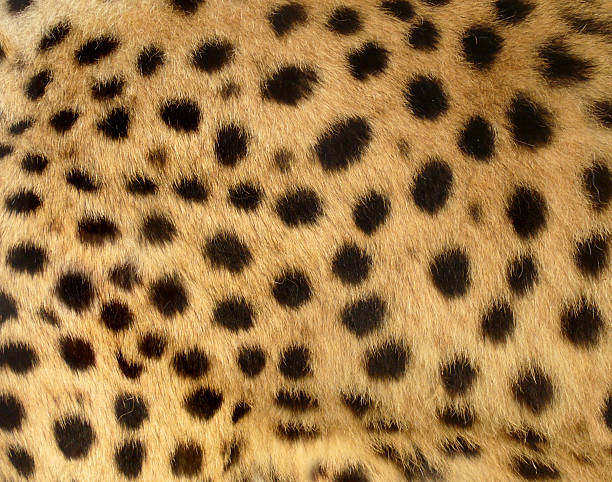
Cheetah
Cheetahs have solid black spots.

Jaguar
Jaguars have rosettes, circles with dots.