
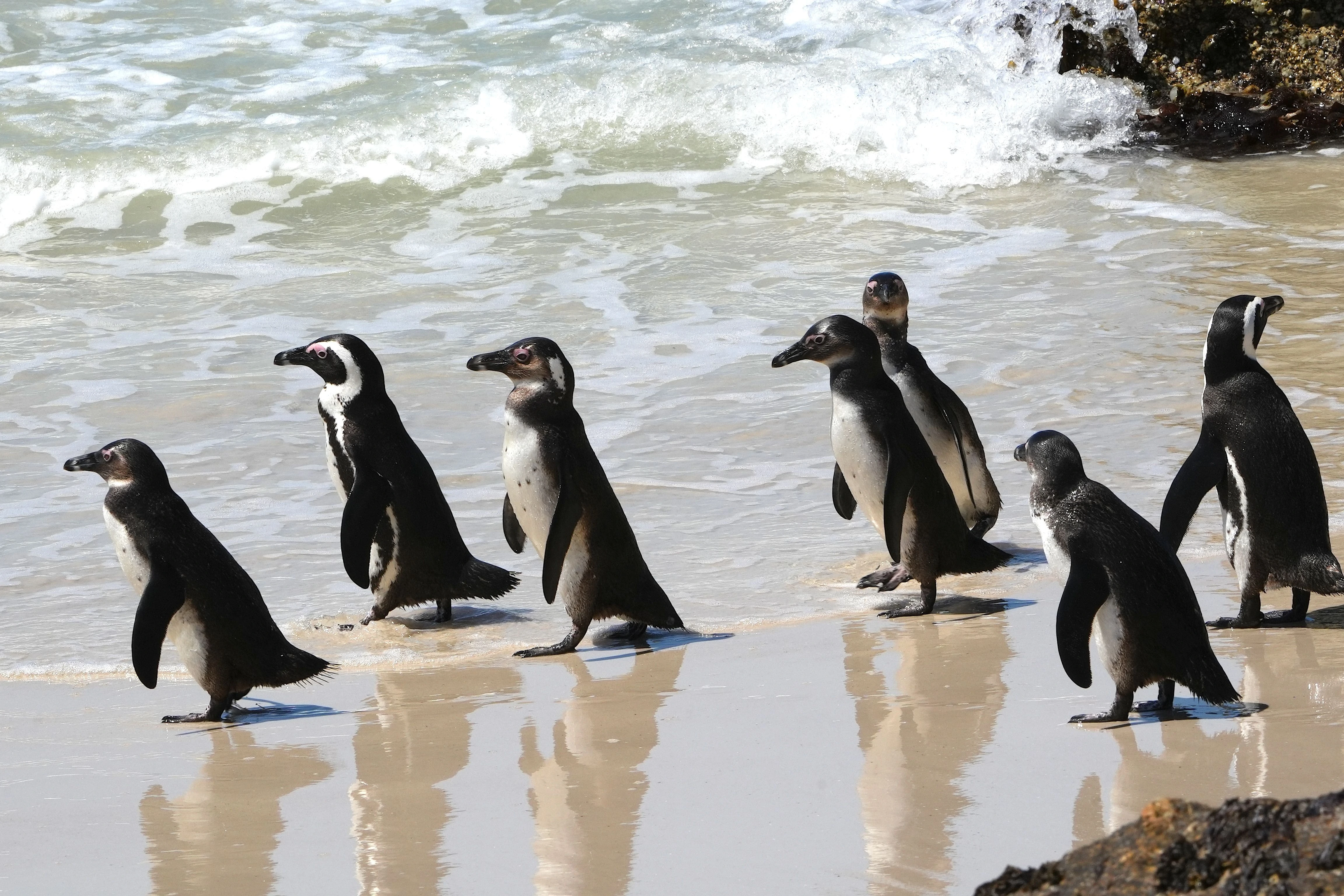
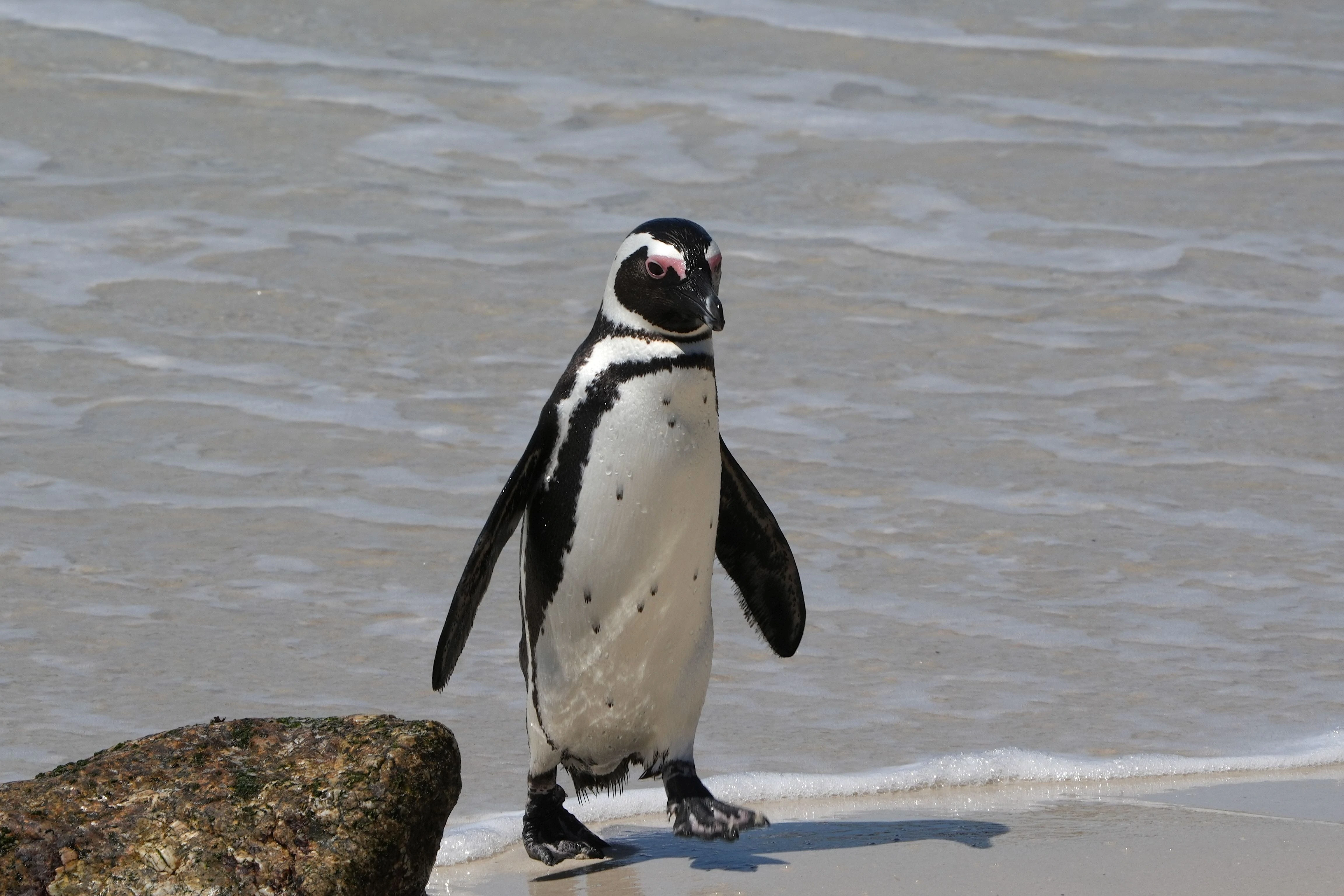
Photographed at Boulders Beach, South Africa
African Penguin (or Black-footed Penguins)
Facts that make it special:
* The only penguin species native to the entire continent of Africa.
* Each penguin has unique black chest patterns, making them all different like our fingerprints.
Bird Info:
Where do they call home? South Africa
What does it look like? Black & white with pale pink above the eyes, black chest patterns, & black & pink spackled webbed feet for swimming.
What is the average bird size? About 24" - 28" tall
How long do they live? up to 20 years in the wild.
What is a group called? Lots of names! Colony or Rookery: large breeding group on land. Waddle: group walking of standing together Raft: group swimming or floating in the water. Huddle: a group standing very close together on land. Crèche: group of young chicks that stay together for safety.
What does their home look like (habitat)? Atlantic Ocean Coastal & Shoreline
What do they eat? Sardines, anchovies, & horse mackerel (small fish)
How do they communicate? They make braying sounds like a donkey.
What do they do all day? Swim and hunt for food, eat, rest & preen in the sun & parent their baby chicks on the sandy beach.
What makes life hard for this bird? Their food supply is declining from overfishing, pollution and climate change.
What role do they play in its ecosystem? They are eaters of small fish & a food source (prey) for larger predators (both in the water and on land predators), like whales, seals, etc.
Current population size: <19,800 or ≈ 10,000 breeding pairs
What is the conservation status? CRITICALLY ENDANGERED
Conservation organization to learn more: SANCCOB Saving Seabirds
Resource: Penguin International & Two Oceans Aquarium



Photographed at Kruger National Park, South Africa
African (Bush/Savanna) Elephant
Facts that make it special:
* The largest mammal on Earth!
* Known for their incredible memory!
*They show emotions, are smart and very social.
Animal Info:
Where do they call home? 23 countries in Africa; with the largest herd living in BotswanaWhat does it look like? Tall & big with dark grey to brown wrinkled thick skin, big fan-like ears that are shaped like the African continent, long nose called a trunk and two big teeth, called tusks, that grow all the time and stick outside the mouth. What is the average animal size? 8-11' tall & up to 15,000 lbs
How long do they live? Up to 70 years!What is a group called? A herd of elephants, typically in family groups.
Two species of African Elephant: Bush/Savanna & ForestWhat does their home look like (habitat)? African savanna of scrubland, grasses & forest
What do they eat? They are Herbivores and only eat plants. All parts of plants (roots, bark, leaves, fruit, stems, grasses).How do they communicate? Trumpeting, low rumbles & screams that can be heard 6 miles away!What do they do all day? They are lead by the oldest female & spend their time eating, walking, drinking, bathing and socializing. Only rest 2-4 hours a day.What makes life hard for this animal? Humans are poaching their ivory tusks to sell for money, they are losing large parts of their habitats to human usage (like livestock raising, farming & places for people to live) & conflicts between humans and elephants because of this. What role do they play in its ecosystem? They are a key stone species; their daily behaviors make habitats for other wildlife. For example: Their large footprints become water sources after a rain for other animals. Their poop (dung) helps spread seeds.Current population size: ≈ 415,000 - 450,000
What is the conservation status? CRITICALLY ENDANGERED African Forest Elephant
ENDANGERED African Bush/Savanna Elephant
Conservation organization to learn more: Save the Elephants
Resources: Sheldrick Wildlife Trust & Save the Elephants


Photographed at Kruger National Park, South Africa
African Wild Dog (Painted Dog)
Facts that make it special:
*Very social animals and care for each other in their pack.
*Alpha male & Alpha female lead the pack of about 20 dogs.
Animal Info:
Where do they call home? South Africa, Botswana, Namibia, Zimbabwe, ZambiaWhat does it look like? Tall and lean, dog-like. Each animal has a unique pattern of black, yellow, white & brown fur, rounded ears and a bushy tail with a white tip.What is the average animal size? 30" - 40" long, stand 2' tall with 12" - 16" tails, weigh 40 -80 lbs.How long do they live? ≈ 10 - 11 years in the wild.What is a group called? A pack of African Wild Dogs. What does their home look like (habitat)? Scrublands and sparse woodlands.What do they eat? Carnivores; Smaller animals like rats, birds, wildebeest calves. They hunt in packs to target larger prey like wildebeest or antelopes. How do they communicate? A variety of methods: yaps to rally for hunting, sneezing to contribute in decision-making a group, 'hoo' calls to find lost members, squeals for the eating order, scent marking for territory marking & use body language to greet each other. What do they do all day? They socialize and rest during the hottest part of the day and hunt at sunrise or towards the evening. They also spend time grooming and caring for pups.What makes life hard for this animal? There is less habitat because of more farming & livestock raising, they can get diseases and have more human-wildlife conflict due to the struggle for habitat.What role do they play in its ecosystem? They are successful hunters that help keep antelope populations down which helps prevent antelopes from overgrazing the land. They leave behind scraps of food for scavengers (birds, hyenas) to eat and their poop distributes nutrients back into the soil.Current population size: > 7,000What is the conservation status? ENDANGEREDConservation organization to learn more: Painted Dog Conservation
Resource: International Fund of Animal Welfare & Painted Dog Conservation


African River Eagle
Facts that make it special:
* The National bird of Namibia, Zambia, Zimbabwe, South Sudan
*It's loud call is the bird call commonly attributed to sounds of Africa.
*They steal food from other birds and are known as kleptoparasites!
(Word meaning: klepto - to steal things.)
Bird Info:
Where do they call home? All over the continent of Africa south of the Sahara desert.
Type of bird: A large raptor (bird of prey) with spines on its claws to carry slippery fish.
What does it look like? White feathers on head, neck, chest & tail. A sierra colored brown body with black feathers on wings.
What is the average bird size? Wingspan 6'-8' & Body 25"-30"; Weighs 4-8 lbs.
How long do they live? ≈ 16- 24 years
What is a group called? Solitary birds but mate for life; from the sea eagle What does their home look like (habitat)? Always near water; lakes, rivers & coasts where they fish and steal food from other birds. Use tall acacia trees to perch and build nests in for raising chicks.
What do they eat? Fish, waterfowl, terrapins (turtles), crocodiles, flamingos & sometimes small mammals.
How do they communicate? They call out loud to defend their territory, have vocal duets with their mate to reinforce their bond and give sharp chirps to warn their mate or chicks of danger.
What do they do all day? Most of their day is spend sitting high in the trees overlooking the water. They hunt mid-morning, eat their catch and spend time bathing or preening after they eat. The afternoon and evening are spent defending their territory and sleeping deeper in the trees to avoid owls and baboons.
What makes life hard for this animal? Baboons, monitor lizards and other raptors threatened their baby chicks in the nesting site. Chemical runoff and pollution threatens its food source and potentially causes fatal poisonings of the birds.
What role do they play in its ecosystem? They are an apex predator and maintain the balance of their habitat's food web.
Current population size: 300,000
What is the conservation status? LEAST CONCERN
Resources: Kruger National Park Bird Guide.& UofM Animal Diversity Web.

Photographed at Crooks Corner, Kruger National Park, South Africa


Photographed at Kruger National Park, South Africa
Black-Backed Jackal
Facts that make it special:
* Named because of its dark colored fur on its back.
*Great scavengers & follow larger predators to clean up after their hunts.
* The word 'jackal' is ancient from the Indian Sanskrit language meaning "the howler".
Animal Info:
Where do they call home? Living in lots of parts of East Africa & Southern Africa
What does it look like? Brown fur coat with a black and grey stripe down its back and along the bushy tail. Large-pointed ears on top it's head.
What is the average animal size? ≈ 15-16" tall & 13-16 lbs; Similiar to a small-to-medium sized dog
How long do they live? ≈ 8-10 years
What is a group called? A Pack of Black-Backed Jackals.
What do they eat? Omnivores/small animals, reptiles, insects, fruit. berries.
What does their home look like (habitat)? Open spaces on the savanna, grasslands, semi-deserts & coastal areas.
How do they communicate? They are the most vocal of the dog (canine) family and have a large variety of sounds, scents and physical body positions.
What do they do all day? They are active during dawn, dusk and nighttime. Typically rest during the hot part of the day. The like to hunt in the early parts of the day and at night.
What makes life hard for this animal? They have to compete for food with larger animlas, have high rates of disease (rabies) and are often hunted by larger animals like leopards, wild dogs and even martial eagles.
What role do they play in its ecosystem? They hunt and help keep smaller animal populations from getting too large, they scavenge for food left by larger animals helping to keep the savanna clean & their poop contains seeds from their diet of berries and fruit which helps scatter seeds.
Population size: Unknown; widespread & breeding is abundant with lots of pups!
What is the conservation status? OF LEAST CONCERN
Resources: UofM Animal Diversity Web


Photographed at Kruger National Park, South Africa
Cape Buffalo
Facts that make it special:
* Known to have a terrible temper! Watch out!
* One of African's 'Big 5' to see on Safari.
*The horns across its head are called a 'boss.'
Animal Info:
Where do they live? Tanzania, South Africa, Botswana, Kenya, Uganda
What does it look like? Large black or dark gray body with horns that are joined at the top of its head & curved at the tips. It's a shield made of bone.
Interesting Fact: Cape Buffalos can typically be seen with birds on it's back eating insects off its skin. The birds seen are oxpeckers & cattle egrets.
What is the average animal size? 5'-6' tall, 1,100 - 2,000 lbs. They are BIG!
How long do they live? 15 -25 years in the wild
What is a group called? A herd of Cape Buffalo.
What do they eat? Herbivores; grazing and eating only grasses. They chew their cud to help digest the grasses.
What type of habitat? Swamps, grasslands, places where there is water. Walk daily to water sources.
How do they communicate? They use a variety of sounds, body language and scents to talk to each other. Some examples: a low-grunt says "let's move" a long maaaa sound is a 'water call' to express they are close to water.
What do they do all day? They eat (graze) or chew its cud and try to stay cool by going to water holes and wallowing in the mud.
What makes life hard for this animal? They are threatened by diseases, the young calves & older ones are hunted by larger predators & their teeth wear down as they age, making it difficult to graze & eat leading to a lack of nutrients they need to survive.
What role do they play in its ecosystem? They eat large amounts of grasses that help reduce wildfires, allows smaller plants to grow & provides areas for smaller antelopes to graze. They are a good source of food for lions.
Current population size: ≈ 400,000
Conservation Status: NEAR THREATENED
Conservation organization to learn more: African Wildlife Foundation
Resources: African Marvel Tours & African Wildlife Foundation


Photographed at Kirstenbosch National Botanical Garden, South Africa
Cape Sugarbird
Facts that make it special:
* Can only be found in South Africa.
*Have long curved beaks that fit into flowers for getting nectar.
* The male birds have tail feathers 3x the length of its body. WOW!
Bird Info:
Where do they call home? Only lives in one country, South Africa
What does it look like? Grayish brown with a yellow spot on the rear end of its body & long flowing tail (the males have longer tails than the females) with a black beak (bill) that curves down.
What is the average bird size? ≈ 13-17" tip of beak to tail
How long do they live? ≈ 4 years
What is a group called? A group or flock of Cape Sugarbirds.
What do they eat? They feed on the nectar of Protea flowers, insects & spiders.
What type of habitat? The fynbos shrub land region of South Africa.
How do they communicate?
What do they do all day?
What makes life hard for this animal? The eggs and baby chicks are in danger from a variety of threats: windy weather & potential of falling out of their nests, being eaten by other animals & invaded by ants. Wild fires can threaten the protea flowers and their food source.
What role do they play in its ecosystem? Primary pollinator of Protea flowers; visiting up to 300 flowers per day!
Population size: 750,000 - 1.2 million (ecological model estimates)
What is the conservation status? OF LEAST CONCERN
Resources: Birding in South Africa & The Table Mountain Fund & Blue Hill Escape


Photographed at Kruger National Park, South Africa
Chacma Baboon
Facts that make it special:
* Largest monkey species in Africa.
*A primate that is closely related to humans.
Animal Info:
Where do they call home? South Africa, Angola, Zambia, Botswana, Namibia, Zambia, Mozambique
Five Species of Baboons: Olive, Yellow, Kinda, Hamadryas, Chacma & Guinea Baboons
What does it look like? Fur is light gray or dark olive brown with a dog-like face with long snout & narrow upper face. Long limbs, tails and short thick hair. Face skin is purplish-black in color. Males have large canine teeth. Females have smaller canine teeth. They walk on all four legs.
What is the average animal size? Up to 45" in body length
How long do they live? 30 - 45 years in the wild
What is a group called? A troop of Chacma Baboons. Live in large troops.
What do they eat? Omnivores: eating all parts of plants (roots, fruit, grasses. seeds...) & birds, reptiles, small mammals, insects, spiders.
What type of habitat? Africa savanna, grasslands & semi-arid areas and areas of water.
How do they communicate? They use a variety of sounds, body language, facial expressions and touches to communicate with each other. Some examples are: a loud wa-hoo bark means this is my territory or to show fighting strength, soft grunts are friendly greetings and grooming each other helps form bonds. They touch noses as a friendly sign.
What do they do all day? Spend day time looking for food, caring for young & at night they sleep in trees or on cliffs to keep them out of reach from predators.
What makes life hard for this animal? Large animals such as leopards, lions, brown hyenas & black-backed jackals hunt Chacma Baboons. African rock pythons and tawny eagles are a threat. Human-animal conflicts exist and can result in death from hunting, car accidents & poisoning.
What role do they play in its ecosystem? Chacma Baboons help spread seeds and improve the soil by flipping over when looking for food, and they are a food source for many animals.
Population size: Unknown
What is the conservation status? 4 of the 5 species OF LEAST CONCERN
Guinea (also called Red Baboon) Baboon: NEAR THREATENED
Resource: Bioexplorer & UofM Animal Diversity Web & SANBI


Photographed at Cheetah Conservation Fund, Namibia
Cheetah
Facts that make it special:
* World's fastest land mammal with speeds up to 70mph!
* Cheetahs purr like a domestic cat and cannot roar.
*Have a 20' stride when running full speed!
Animal Info: (LOTS MORE info - Cheetah tab)
Where do they live? Namibia, Kenya, South Africa, Horn of Africa, Tanzania, small population in Iran & reintroduced in India
What does it look like? Yellowish-beige fur with solid black spots, long legs, long tail with white & black stripes, rounded ears, & black stain marks either side of nose.
What is the average animal size? 28-36" tall, up to 7.5' nose to tip of tail
What is a group called? Only males form groups called coalitions.
How long do they live? In the wild 10 -12 years.
What do they eat? Smaller antelopes, hare, rodents, birds, young warthogs
What type of habitat? African savanna, grassland
How do they communicate? They vocalize sounds, use body language & scent marking. They can chirp, meow, growl, hiss, spit and stutter. Use urine & poop to mark territory, leave messages for other cheetahs & indicate reproduction time.
What do they do all day? They are cats! They rest and sleep a lot! They hunt during the early morning or late afternoon when it is cooler. If cubs are around then the mama cheetahs spends her day taking care of them; grooming, playing, teaching them to hunt.
What makes life hard for this animal? They have good hunting success but often their meal is stolen by lions, hyenas, or wild dogs. Cheetahs will not fight to keep their food but take 'flight' and leave the food to the larger animals. Their habitat is fractured by fencing and farms, poachers kill them for their fur and/or the cubs. Cubs are then sold into the illegal pet trade.
What role do they play in its ecosystem? Cheetahs are apex predators and are one of the BEST hunters on the savanna hunting a variety of species. This helps keep the biodiversity of the ecosystem healthy and viable for all species. If cheetahs were not present in the ecosystem it would cause an imbalance & decrease in the biodiversity needed for a healthy ecosystem.
Current population size: ≈ 7,000 total wild cheetahs
Conservation Status: 3 of the 5 subspecies are CRITICALLY ENDANGERED or ENDANGERED
Conservation organization to learn more: Cheetah Conservation Fund
Resource: Cheetah Conservation Fund & Cheetah Kids Eplorer


Photographed at Kruger National Park, South Africa
Nile Crocodile
Facts that make it special:
* In Africa there are ONLY crocodiles. There are no alligators.
*They have the STRONGEST bite force of any animal!
Reptile Info:
Where do they call home? Lots of countries in Africa: South Africa, Botswana, Egypt, Ethiopia, Ivory Coast, Kenya, Madagascar, Mozambique, Namibia, Somalia, Swaziland, Zambia, Zimbabwe.
What does it look like? A long, low to the ground body covered in scales that are bony plates. Four short legs, webbed hind feet and muscular pointed tail. Their green eyes, ears & nostrils are on top of the head. Greyish in color. Huge mouth with lots of teeth! They lose and grow new teeth numerous times over long lifespan.
What is the average animal size? 11' - 16' 5" in body length & second largest crocodile in the world!
How long do they live? 70 -100 years in the wild!
What is a group called? A group of crocodiles on land is called a bask. A group of crocodiles in the water is called a float.
What do they eat? Young crocodiles eat mostly water-based food (fish, other reptiles, tadpoles/frogs), adult crocodiles can eat larger vertebrates, like antelope, buffalo, young hippos, and even large cats.
What type of habitat? They live near freshwater sources like rivers, swamps, lakes, & marshes.
How do they communicate? They vocalize with sounds, use physical signals and body postures. They rumble, roar, hiss and bark out.
What do they do all day? They are cold-blooded reptiles & spend hours sunbathing to raise their core temperatures. Late afternoon they have energy to socialize & digest food. They hunt at night since they are nocturnal.
What makes life hard for this animal? The eggs and young hatchlings are very vulnerable. Birds, Nile Monitor lizards, snakes, large fish and even hyenas prey on the eggs & young hatchlings. Human-crocodile conflicts on riverbanks & lakeshores. Habitat destruction & pollution cause health issues.
What role do they play in its ecosystem? They help maintain the health, balance and biodiversity of the waterways. For example, they eat many species and help to keep the population of animals from overgrazing the lakes and riverbank and fish from getting too populated. They eat animals that are rotting in the water and help stop bacteria from spreading.
Population size: 50,000 - 70,000
What is the conservation status? LEAST CONCERN
Resources: World Land Trust & African Conservation Foundation


Kori Bustard Bird
Facts that make it special:
* Africa's heaviest bird at 40 lbs. (19kg)
* They suck their water up (like a straw!) instead of scooping it in like other birds.
Bird Info:
Where do they call home? Botswana, Zimbabwe, Namibia, southern Angola, South Africa and southern Mozambique, Ethiopia, Kenya and Tanzania,
What does the word 'bustard' mean? The word 'bustard' means birds that walk.
Type of bird: Kori Bustard typically stay on the ground and are land birds.
What does it look like? Large long-legged with a patterned gray-brown body, a long speckled light colored neck, a black crown on the head with a little crest & white stripe above the eyes.
What is the average bird size? Wingspan 7'-9' wide & Males are bigger with bodies 4'-5' tall, weigh 40 lbs. & Females stand 2 - 3' tall, weigh up to 15 lbs.
How long do they live? Unknown in the wild; in captivity 25 - 30 years
What is a group called? Solitary birds until mating time & males are seen in groups called a lek that form around a female to show off; females often seen with baby chicks.
What do they eat? Omnivore; eating both plants (berries) & small rodents, snakes & lizards plus insects like locust & dung beetles. They have big appetites!
What type of habitat? Scrubland, grasslands & semi-deserts; near water sources.
How do they communicate? Usually quiet although they use sounds & body postures to attract mates. Use a bark sound to signal alarm while females growl & roar to protect the chicks & grunts to tell the chicks it's time for food. They also snap their bills to show excitement & dominance.
What do they do all day? They are diurnal & spend most of their day walking slowly across the savanna pecking & eating food, grooming by taking dust baths & resting in shade during the midday heat.
What makes life hard for this animal? Lions, leopards, caracals, jackals and eagles prey on Kori bustards. The eggs and chicks are often eaten by birds, snakes and jackals. Power-line collisions, habitat destruction & poaching are also threats.
What role do they play in its ecosystem? They are pest & rodent controllers, reducing their populations. They spread seeds as they eat & poop along the savanna.
Current population size: ≈ 20,000 - 30,000 estimated
What is the conservation status? NEAR THREATENED
Resource: Kruger National Park & UofM Animal Diversity Web

Photographed at Etosha National Park, Namibia


